Wednesday, May 13, 2020

Saturday, April 25, 2020
Thursday, April 16, 2020
LANGUAGE AND GEOGRAPHY
Conversely, the languages of some different countries may be much closer than those spoken within the same country. Romanian and Moldavian are essentially the same languages just with different names, and Serbian and Croatian are fundamentally the same except that Serbian uses the Cyrillic alphabet and Croatia uses Western characters. Although Celtic Gaelic speakers of Scotland generally cannot understand the Celtic spoke in nearby Wales, they are usually able to understand the Celtic spoken much further afield in the Brittany region of France. The so-called Romance languages (such as French, Italian, Spanish, Portuguese and Romanian) all developed out of Latin, and there remain many parallels between the languages, to the extent that Spaniards can usually understand written Italian and Portuguese (and vice versa) sufficiently well to carry on a correspondence, although spoken conversation tends to be more difficult. The modern language that most closely resembles ancient Latin is Lugurodese, an Italian dialect spoken in central Sardinia, although it should be remembered that classical Latin was exclusively a literary and scholarly language, and spoken or "vulgar" Latin (out of which the Romance languages largely developed) was substantially different. Romania, isolated in Eastern Europe and surrounded only by Slavic languages, is closer to Latin than even Italian, and is the only Romance language to keep the declensions and the neuter gender from classical Latin. Most of the languages of Europe developed out of the Indo-European family of languages, however there are some exceptions. The Basque language, spoken in a small area of northeastern Spain and southwestern France, is a completely unrelated language isolate, as is the Georgian language of the Caucasus region of eastern Europe. Maltese is a Semitic language, closer to Arabic but written using the Latin alphabet. Estonian, Finnish and Hungarian are all Finno-Ugric languages, a subfamily of the Uralic language family. Turkish is a Turkic language, more closely related to the Altaic languages of Mongolian, Korean and Japanese than to Indo-European languages. |

Multilingual speakers outnumber monolingual speakers in the world's population. By some estimates, 50% of the population of Africa is multilingual. Some countries have not just two or three languages but hundreds, and India boasts 1,600 languages and dialects. South Africa has no less than eleven official languages: Afrikaans, English, Southern Ndebele, Northern Sotho, Southern Sotho, Swazi, Tsonga, Tswana, Venda, Xhosa and Zulu. In West Africa, an English-based pidgin language, developed during the Atlantic slave trade years, still serves as a common lingua franca between several different countries with distinct and mutually unintelligible languages. But not all speakers in a multilingual society need to be multilingual. Some countries may have multilingual policies and recognise several official languages (such as English and French in Canada), but particular languages may be associated only with particular regions in the state (e.g. Québec, New Brunswick). In Scandinavia, many, if not most, speakers of Swedish and Norwegian (and also of Norwegian and Danish) can communicate with each other by speaking their respective languages, and just avoiding words that are not found in the other language, or that may be misunderstood. A similar phenomenon occurs in Argentina, where the similar but distinct languages of Spanish and Italian are both widely spoken. Multiple languages within a country can also lead to political problems, as witnessed by the simmering resentment of the Dutch-speaking majority in Belgium, the sometimes radical tactics of the French-speaking Québecois in Canada and Welsh language campaigners in English-dominated Wales, and the full-blooded terrorism of the Basque organization ETA in the name of linguistic and cultural independence. However, despite such activism, and apparently regardless of government support or otherwise, minority languages in multilingual countries are generally on the decline. There have been isolated victories, such as the increasing usage of Hawaiian and Scottish Gaelic, but there have been many more set-backs. For instance, Irish Gaelic appears moribund, and even Welsh is still declining slowly despite the investment of millions in government money. The last native speaker of Manx, a Celtic language spoken on the tiny Isle of Man, died in the 1960s. Further afield, Ubykh, a highly complex Caucasian language with 82 consonants and just 3 vowels, once spoken by 50,000 people in the Crimea region of eastern Europe, went the same way in 1992. |
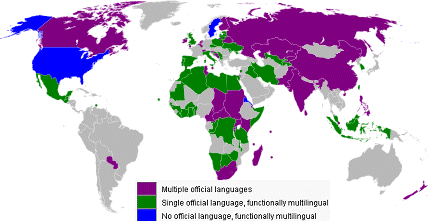
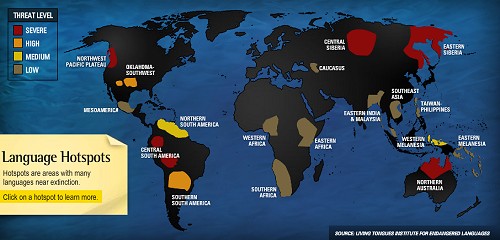
The issue is far from clear, though. Some languages in Indonesia, for example, may have tens of thousands of current speakers, but may nevertheless be endangered because children are no longer learning them, as speakers shift to using the national Indonesian language (or a local Malay variety) in place of local languages. Others, like the Andamanese languages of the Andaman Islands in the Bay of Bengal, may have only a hundred speakers each, but may be considered very much alive if they are the primary language of a community and the first (or only) language of all children in that community. It is possible to revitalize dead or moribund languages. Hebrew is perhaps the only example of a language which has gone from being extinct as a spoken language to being a national language with millions of first language speakers. But Cornish has also been successfully revived, after well over a century of extinction, and now has a growing number of speakers (currently in the thousands). Attempts to revitalise Irish Gaelic, Welsh in Wales, Galician in Galicia, Basque in Basque Country, Catalan in Catalonia and some Amerindian languages have, however, met with mixed success. see original: https://www.thehistoryofenglish.com/issues_geography.html#Multilingual%20Countries |
The history of English
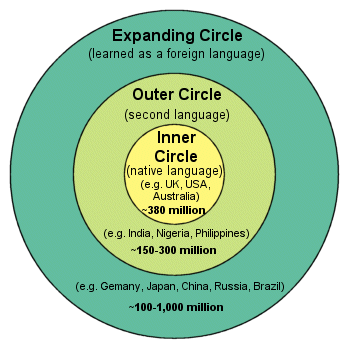
It should be noted here that statistics on the numbers around the world who speak English are unreliable at best. It is notoriously difficult to define quite what is meant by “English speaker”, let alone the definitions of first language, second language, mother tongue, native speaker, etc. What level of competency counts? Does a thick creole (English-based, but completely incomprehensible to a native English speaker) count? Just to add to the confusion, there are at least 40 million people in the nominally English-speaking United States who do NOT speak English. In addition, the figures, of necessity, combine statistics from different sources, different dates, etc. You may well see large variations on any statistics quoted here. But best recent estimates of first languages suggest that Mandarin Chinese has around 800-850 million native speakers, while English and Spanish both have about 330-350 million each. Following on, Hindi speakers number 180-200 million (around 240 million, or possibly much more, when combined with Urdu), Bengali 170-180 million, Arabic 150-220 million, Portuguese 150-180 million, Russian 140-160 million and Japanese roughly 120 million. If second-language speakers are included, Mandarin increases to around 1 billion, English to over 500 million, Spanish to 420-500 million, Hindi/Urdu to around 480 million, and so on, although some estimates for English as a first or second language rise to over a billion. In fact, among English speakers, non-native speakers may now outnumber native speakers by as much as three to one. In terms of total population, in a world approaching 7 billion, the top three countries by population are China (1.3 billion), India (1.2 billion) and USA (about 310 million), followed by Indonesia, Brazil, Pakistan, Bangladesh, Nigeria, Russia and Japan. Thus, the USA is by far the most populous English-speaking country and accounts for almost 70% of native English speakers (Britain, by comparison has a population of just over 60 million, and ranks 22nd in the world). India represents the third largest group of English speakers after the USA and UK, even though only 4-5% of its population speaks English (4% of over 1.2 billion is still almost 50 million). However, by some counts as many as 23% of Indians speak English, which would put it firmly in second place, well above Britain. Even Nigeria may have more English speakers than Britain according to some estimates.
Although falling short of official status, English is also an important language in at least twenty other countries, inluding several former British colonies and protectorates, such as Bahrain, Bangladesh, Brunei, Cyprus, Malaysia and the United Arab Emirates. It is the most commonly used unofficial language in Israel and an increasing number of other countries such as Switzerland, the Netherlands, Norway and Germany. Within Europe, an estimated 85% of Swedes can comfortably converse in English, 83% of Danes, 79% of Dutch, 66% in Luxembourg and over 50% in countries such as Finland, Slovenia, Austria, Belgium, and Germany. If the “inner circle” of a language is native first-language speakers and the “outer circle” is second-language speakers and official language countries, there is a third, “expanding circle” of countries which recognize the importance of English as an international language and teach it in schools as their foreign language of choice. English is the most widely taught foreign language in schools across the globe, with over 100 countries - from China to Russia to Israel, Germany, Spain, Egypt, Brazil, etc, etc - teaching it to at least a working level. Over 1 billion people throughout the world are currently learning English, and there are estimated to be more students of English in China alone than there are inhabitants of the USA. A 2006 report by the British Council suggests that the number of people learning English is likely to continue to increase over the next 10-15 years, peaking at around 2 billion, after which a decline is predicted. |
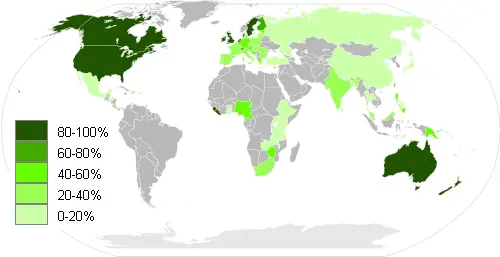
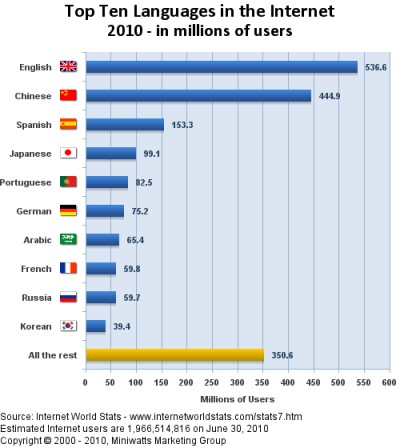
Over 90% of international airlines use English as their language of choice (known as “Airspeak”), and an Italian pilot flying an Italian plane into an Italian airport, for example, contacts ground control in English. The same applies in international maritime communications (“Seaspeak”). Two-thirds of all scientific papers are published in English, and the Science Citation Index reports that as many as 95% of its articles were written in English, even though only half of them came from authors in English-speaking countries. Up to half of all business deals throughout the world are conducted in English. Popular music worldwide is overwhelmingly dominated by English (estimates of up to 95% have been suggested), and American television is available almost everywhere. Half of the world newspapers are in English, and some 75% of the world mail correspondence is in English (the USA alone accounts for 50%). At least 35% of Internet users are English speakers, and estimated 70-80% of the content on the Internet is in English (although reliable figures on this are hard to establish). Many international joint business ventures use English as their working language, even if none of the members are officially English-speaking. For example, it is the working language of the Asian trade group ASEAN and the oil exporting organization OPEC, and it is the official language of the European Central Bank, even though the bank is located in Germany and Britain is not even a member of the Eurozone. Switzerland has three official languages (German, French and Italian and also, in some limited circumstances, Romansh), but it routinely markets itself in English in order to avoid arguments between different areas. Wherever one travels in the word one see sees English signs and advertisements. |
But a more amusing exercise is to piece together the English derivations of foreign words where phonetic spelling are used. To give a few random examples, herkot is Ukrainian for “haircut”; muving pikceris is Lithuanian for “movie” or “moving pictures”; ajskrym is Polish for “ice-cream”; schiacchenze is Italian for “shake hands”; etc. Japanese has as many as 20,000 anglicisms in regular use (“Japlish”), including apputodeito (up-to-date), erebata (elevator), raiba intenshibu (labour-intensive), nekutai (neck-tie), biiru (beer), isukrimu (ice-cream), esukareta (escalator), remon (lemon), mai-kaa (my car) and shyanpu setto (shampoo and set), the meanings of which are difficult to fathom until spoken out phonetically. “Russlish” uses phonetic spellings such as seksapil (sex appeal), jeansi (jeans), striptiz (strip-tease), kompyuter (computer), chempion (champion) and shusi (shoes), as well as many exact spellings like rockmusic, discjockey, hooligan, supermarket, etc. German has invented, by analogy, anglicisms that do not even exist in English, such as Pullunder (from pullover), Twens (from teens), Dressman (a word for a male model) and handy (a word for a cellphone). After many centuries of one-way traffic of words from French to English, the flow finally reversed in the middle of the 20th Century, and now anywhere between 1% and 5% of French words are anglicisms, according to some recent estimates. Rosbif (roast beef) has been in the French language for over 350 years, and ouest (west) for 700 years, but popular recent “Franglais” adoptions like le gadget, le weekend, le blue-jeans, le self-service, le cash-flow, le sandwich, le babysitter, le meeting, le basketball, le manager, le parking, le shopping, le snaque-barre, le sweat, le marketing, cool, etc, are now firmly engrained in the language. There is a strong movement within France, under the stern leadership of the venerable Académie Française, to reclaim French from this onslaught of anglicisms, and the country has even passed laws to discourage the use of anglicisms and to protect its own language and culture. New French replacements for English words are being encouraged, such as le logiciel instead of le soft (software), le disc audio-numérique instead of le compact disc (CD), le baladeur instead of le walkman (portable music player), etc. In Québec, the neologism le clavardage (a portmanteau word combining clavier - keyboard - and bavardage - verbal chat) is becoming popular as a replacement for the common anglicism le chat (in the sense of online chat rooms). Norway and Brazil have recently adopted similar measure to keep English out, and this kind of lexical invasion in the form of loanwords is seen by some as the thin end of the wedge, to be strenuously avoided in the interests of national pride and cultural independence. |
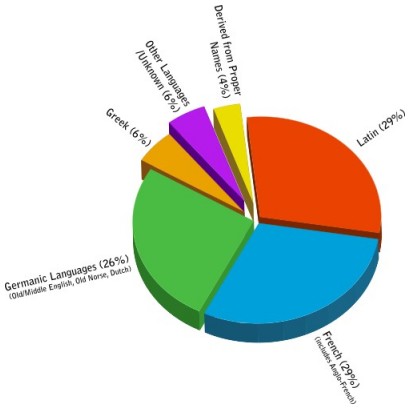
Just how many words there currently are in the English language is open to conjecture. The Global Language Monitor (a Texas-based company that analyzes and tracks worldwide language trends) claims that the English language now boasts over a million words, but in reality it is almost impossible to count the number of words in a language, not least because it is so hard to decide what actually counts as a word. For instance, how are we to treat abbreviations, hypenated words, compound words, compound words with spaces, etc? The latest full revision of the “Oxford English Dictionary”, published in 1989 and considered the premier dictionary of the English language, contains about 615,000 word entries, listed under about 300,000 main entries. This includes some scientific terms, dialect words and slang, but does not include more specialized scientific and technical terms, nor the large number of more recent neologisms coined each passing year. "Webster's Third New International Dictionary”, published in1961, lists 475,000 main headwords. The working vocabulary of the average English speaker, though, is notoriously difficult to assess (it is hard enough to count the words used in written works - estimates of the number of words in the “King James Bible” range from 7,000 to over 10,000, and estimates of Shakespeare’s vocabulary range from 16,000 to over 30,000). An average educated English speaker has perhaps 15,000 to 20,000 words at his or her disposal, although often only around 10% of these are used in an average week’s conversation (typically, we "know" at least 25% more words than we ever actually use). Some studies suggest that just 43 words account for fully half of the words in common use, and just 9 (and, be, have, it, of, the, to, will, you) account for a quarter of the words in any random sample of spoken English. The English lexicon includes words borrowed from an estimated 120 different languages. Attempts have been made to put in context the various influences and sources of modern English vocabulary, although this is necessarily an inexact science. Some studies have put Germanic, French and Latin sources more or less equal at between 26-29% each, with the balance made up of Greek, words derived from proper names, words with no clear etymology and words from other languages. Other studies put the French input higher, the Latin lower and suggest that other languages have contributed as much as 10% of the vocabulary. None of the studies is considered definitive.
The sheer number of English synonyms can make for a rather unwieldy and untidy language at times, though, and its embarrassment of riches can sometime seem a little gratuitous and unnecessary. This is particularly evident in the large number of redundant phrases (composed of two or more synonyms) which are in everyday use, e.g. beck and call, law and order, null and void, safe and sound, first and foremost, trials and tribulations, kith and kin, hale and hearty, peace and quiet, cease and desist, rack and ruin, etc. Also, despite the sheer volume of words in the language, there are still some curious gaps, which have arisen through quirks in its development over the centuries, such as the unused positive forms of common negative words like inept, ineffable, dishevelled, disgruntled, incorrigible, ruthless, disastrous, incessant and unkempt, most of which used to exist but have died out for unknown reasons. Perhaps even stranger, given the generous availability of words, is English’s tendency to load single words with multiple meanings. For example: fine has at least 14 definitions as an adjective, 6 as a noun, 2 as a verb and 2 as an adverb; round has 12 uses as an adjective, 19 as a noun, 12 as a verb, 1 as an adverb and 2 as a preposition; set has an incredible 58 uses as a noun, 126 as a verb and 10 as an adjective (the "Oxford English Dictionary" takes about 60,000 words - the length of a short novel - to describe them all). As in any language, meanings have shifted over time, sometimes many times, but in some cases the same word can has even ended up with two contradictory meanings (contranyms), examples being sanction (which has conflicting meanings of permission to do something, or prevention from doing something), cleave (to cut in half, or to stick together), sanguine (hot-headed and bloodthirsty, or calm and cheerful), ravish (to rape, or to enrapture), fast (stuck firm, or moving quickly), oversight (watchful control, or something not noticed), etc. |
Often, the desire to standardize the language, such as occurred with the introduction of the printing press, has itself led to anomalies and inconsistencies in its spelling, or has at least frozen existing inconsistencies in place. Spelling reform, which took place at various times, both in Britain and particularly in the United States, has further complicated the picture, despite a professed desire for simplification, and we now have many differences between American and British spellings to add to its intrinsic difficulties (e.g. realize/realise, center/centre, dialog/dialogue, aging/ageing, traveler/traveller, etc). Although English has “only” forty to fifty different sounds (still much more than many languages), there are over 200 ways of spelling those sounds. For instance, the sound “sh” can be spelled in a bewildering number of different ways (as in shoe, sugar, passion, ambitious, ocean, champagne, etc); a long “o” can be written as in go, show, beau, sew, doe, though, depot, etc; a long “e” can be spelled as in me, seat, seem, ceiling, siege, people, key, machine, phoenix, paediatric, etc; and a long “a” can be rendered as in hey, stay, make, maid, freight, great, etc. As George Bernard Shaw pointed out, the word fish could just as easily be spelled ghoti, using the “gh” sound in enough, the “o” sound from women, and the “ti” from the middle of nation. There is a whole catalogue of silent letters in English, often letters that were added to spellings during the English Renaissance out of a misplaced desire for etymological authenticity, or existing letters that have ceased to be pronounced for one reason or another. In fact, of the 26 letters of the alphabet, only 5 (F, J, Q, V and X) are NEVER silent! There are too many to detail, but some examples include: the silent “b” in comb, debt, climb, etc; the silent “c” in scene, scent, science, scissors, etc; the silent “k” in knife, knock, know, etc; the silent “n” in damn, hymn, column, etc; the silent “p” in psalm, psychiatry, ptarmigan, etc; the silent “gh” in night, through, taught, etc; the silent “g” in gnome, gnaw, sign, etc; the silent “l’ in palm, salmon, yolk, etc; the silent “u” in biscuit, building, tongue, etc; the silent ”w” in wreck, knowledge, sword, etc; and the silent “h” in hour, honour, honest, etc, as well as in annihilate, vehement, vehicle, ghost, rhyme, rhubarb, rhythm, exhaust, exhibition, exhort, etc. English has many words which are identical in meaning but different in spelling and pronunciation, otherwise known as synonyms. But it also has homophones or heterographs (words with different spellings and different meanings, but identical pronunciation), such as hour and our, plane and plain, right, wright, write and rite, etc; homographs or heteronyms (words with identical spellings, but different meanings and pronunciations), such as axes, bass, defect, desert, record, tear, etc; and true homonyms (words with the same spelling and the same pronunciation, but different meaning), such as stalk, bank, fluke, etc.
The sheer variety of English spelling is formidable. There are words with five consecutive vowels (queuing); words with technically no vowels (rhythm, pygmy); words with six consecutive consonants (catchphrase, watchstrap); words with alternating vowels and consonants (overimaginitive, versimilitudes); words with triple letters (headmistressship, bulllike); words that include eight of the same letter (possessionlessness); long words which use none of the same letters (e.g. uncopyrightable); words spelled the same way backwards as forwards (deified, racecar, rotator); etc, etc. see original;https://www.thehistoryofenglish.com/history_today.html |
Tuesday, March 17, 2020
Monday, March 16, 2020
Subscribe to:
Posts (Atom)